It’s been a few weeks now since Covid-19 has taken Sri Lanka by storm and shaken our tiny island to its core. The virus has left us rightfully worried, panicked and the daily patterns we were so accustomed to in shambles. To top it off, most areas across the island are experiencing curfews and lockdowns, disrupting all the norms that we once took for granted.
Everything sure does look bleak and dreary, what with shops and restaurants closed, schools closed, workplaces shut down and with no prospect of a nice family dinner out or a fun shopping spree. With people stuck at home, governments confused at what to do next and economies crashing, the future doesn’t look too rosy.
But wait a minute, haven’t we learnt that with every calamity that comes, there’s a lesson to be learnt and goodness to be seen? Yes, even with this Covid 19 pandemic sweeping across the globe, there is a sunny side to things and we have to learn to see it .
This Coronavirus has forced all of us, the rich, the poor, the affluent and the needy to stay at home, stay indoors and stay safe. It did feel like a holiday for the first few days, a welcome respite from the daily grind of life. But as the days go by and the future looking increasingly uncertain, staying at home is becoming difficult with every passing hour.
But it doesn’t necessarily have to be that way.
If there’s one thing that this tiny virus has taught us, it is learning to take pleasure in the small things in our everyday life – the things we so often took for granted and the things we always overlooked. It has taught us – or rather – forced us to look and really focus at the normal aspects of life that we ignored for so long.
Every cloud does have a silver lining and I’m beginning to understand its true implications now. Take, for example, the government orders for workplaces and offices to close down and for whomsoever it is possible to work from home, to continue to do so. The time off my hectic work schedule has given me ample opportunities and the freedom of mind to make new plans for my business and also brainstorm innovative ideas for my company. I wouldn’t have been able devote time for this if I didn’t have the time I now enjoy away from work.
Staying home without work doesn’t mean being unproductive at all. We live in a day and age where there are countless possibilities so you need to grab hold and make the most out of it. If the circumstances allow you, work digitally, stay connected with your workplace and your colleagues online and you’ll see what a refreshing change it is to work from home. After all, you’re in a place where you can be at your element and let all those creative juices flow. And that’s precisely how the team at Epitom is working from home at the moment. We may not be connected physically at a workplace, but we are very much digitally connected, thanks to technology so we’re covering pretty much the same workload in a safer and more efficient manner.
Image: The Pick a Book and Epitom Team, staying indoors, staying safe, staying connected and successfully managing to continue to take the company forward.
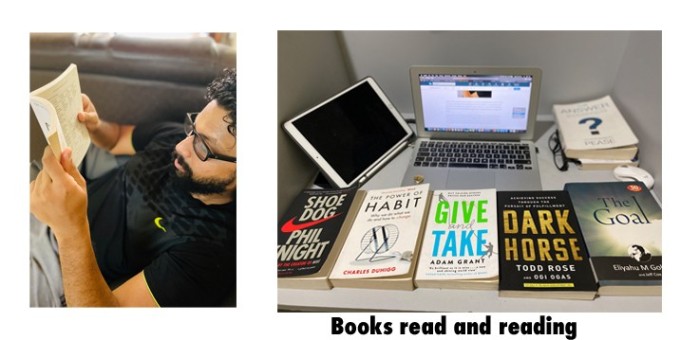
With so much time on my hands, I was also able to get some much needed reading done too. Reading has always been a passion of mine but with work commitments, I wasn’t able to read as much as I would have liked to. Although I always made sure I made the time to squeeze in a book or two with my busy timetable, this curfew situation has given me ample time to read three great books and I have four more lined up on my to-be-read list which I’m really looking forward to.
Plus, with more time on my hands now, I’m finding reading even more enjoyable and more therapeutic than usual. Afterall, reading is the one thing that gives you a sense of escapism during these trying times at home.
Image: Reading makes sure you fill in those long hours with something that is refreshingly beneficial for both mind and body.
Speaking of books and reading, Pick A Book is still up and running, albeit in a different mode. Our PAB members together with our new Indian club members are staying connected online, discovering new books, discussing the books read and generally enjoying being part of an amazing book club and reveling in the joy that only literature can bring.
Image – Session for PAB members in India and Sri Lanka
Another hobby of mine has been rekindled with staying at home during the curfew. Though I’ve always made time for some gardening with my busy schedule, I’ve more time on my hands now to thoroughly enjoy getting my hands in the soil. I’ve found that my gardening sessions these days have been more therapeutic and I’m finding immense joy working with nature.
Image: There’s no better way than giving back to Mother Nature, repairing the damage we’ve unconsciously caused by doing our part, even if it’s something as small as doing a bit of gardening.
Anyone who knows me knows how much I love my dogs. I enjoy the time bonding with them and pet lovers know how much joy, happiness and fulfillment pets can bring. Plus, there’s no denying the fact that my dogs are overjoyed that I get to spend quality time with them, and the way their eyes light up when they see me makes it all the more worthwhile. Usually, I’m home only after eight and I come all tired and drained out, meaning my dogs didn’t get to spend time with me as much as they or I would like to. Now, with extra time on my hands, I get to spend quality time with my pets – something that both my dogs and I desperately wanted.
Image: Me enjoying the extra time I’ve with my dogs. There are few things that are more rewarding than bonding with your pets.
Then, I’ve ticked one more thing off my to-do-list – an all-important one and that is getting back in shape. I’ve got my treadmill all up and working and have a workout schedule in place. We all know how important it is to keep ourselves fit and with me staying at home now, I’m starting to make simple workouts a habit of mine so that once everything is back and running again, I’ll still find time to keep doing my workouts. You don’t need expensive equipment to get fit. Simply going for a walk around your garden, or following a simple workout routine even without any equipment is going to do you a lot of good in the long run.
Image: There’s no better time than now to get into the habit of working out, staying fit and giving your body the care and attention it needs.
I’ve also started honing my mediocre cooking skills. Who knew that cooking could be this fun! I’ve been experimenting with my culinary skills and found that it’s actually quite fun whipping up a dish. Cooking is definitely one thing that I’m going to continue doing once everything is back to normal.
Another thing this time off work and curfew has given me is the chance to further work on my first book. With more time on my hands, my mind refreshed and with newer perspectives, there’s a great deal of new information on my book. Within the given time period I have written more than 30 pages. Likewise, if you have always had a dream to work on a book or project, then this free time that you have in your hands right now is a treasure that you simply cannot waste. Use this time wisely; you’ll thank yourself later for it.
While it’s true that the worry of where this pandemic will lead to is there, it’s also true that this virus has taught us the value of enjoying the small things in life. There’s really no need to moan about how bored you are or how sitting about listlessly at home is frustrating when there are so many ways you can be productive. There’s no use in sitting around moping at home for things that we have no control over. Instead take this time off and see it as a gold mine from God – a chance for us to live our life truly. Be it gardening, reading or completing some project you’ve always put off, this is the time for you to get going. Use this opportunity to the best of your ability and you’ll notice how productive you can be.
It took a tiny, microscopic virus to bring us to our knees and then lift our heads and see what life truly meant, to learn to enjoy the small, simple things and to value family and friends. It taught us what compassion is, what humanity is. It took a virus to bind our feet and keep us home and truly value the time we spend with our family and to show us where our connections lie. It took a pandemic for us to realize that we have been treating this earth with contempt and it’s time now to learn to heal it and treat it with respect.
So, instead of taking this as a trial, take it as an opportunity to plan. Stay safe, follow the rules and stay indoors, plan the future, and, God willing, we can make it out of this together, having learnt some things that have truly added value and meaning to our lives.






 Ragulan Tharmakulasingam